There's nothing quite like the sudden silence of a power outage to remind you how much you rely on electricity for daily life. From keeping food fresh to staying warm (or cool) and powering essential medical devices, a dependable backup generator isn't a luxury—it's a necessity for peace of mind. But wading through the options can feel overwhelming. How do you ensure you're choosing the right generator that won't leave you in the dark or waste your hard-earned money?
The secret lies in proper sizing and selecting your home backup generator. Too small, and your critical appliances won't run; too large, and you’re overspending on fuel and an unnecessary upfront cost. This guide will walk you through the precise steps to match a generator to your specific needs, ensuring you invest wisely in a robust, reliable power solution.
At a Glance: Your Generator Buying Checklist
- Prioritize Your Needs: Decide if you need whole-home power, essential circuits only, or just portable power for a few devices.
- List Your Appliances: Compile a detailed inventory of every device you plan to power.
- Understand Watts: Differentiate between "Running Watts" (continuous power) and "Starting Watts" (initial surge).
- Calculate Peak Demand: Sum running watts, then factor in the highest starting watt surge to determine your maximum simultaneous power need.
- Add a Safety Buffer: Include an extra 20-25% to your peak demand calculation for efficiency and future expansion.
- Choose the Right Type: Select between portable, inverter, or whole-home (standby) generators based on your calculated wattage and lifestyle.
- Prioritize Safety: Always operate generators outdoors, far from your home, and ensure professional installation of a transfer switch.
Why a Home Backup Generator Isn't Just a "Nice to Have" Anymore
Imagine losing power for days, perhaps even weeks. The consequences extend far beyond mere inconvenience. Food spoils, pipes can freeze, critical medical equipment fails, and communication becomes challenging. In an era of unpredictable weather events—from severe ice storms and hurricanes to wildfires and grid overloads—a reliable home generator backup has transitioned from an emergency luxury to a fundamental aspect of home preparedness.
Having your own power source ensures continuity, allowing you to maintain essential services and keep your family safe and comfortable when the unexpected happens. It's an investment in resilience, protecting your home and lifestyle against the increasing frequency and duration of power outages.
Decoding the Power Players: Types of Generators
Before diving into wattage calculations, it's crucial to understand the main types of generators available. Each serves a different purpose, offering varying levels of power, portability, and convenience.
1. Portable Generators: Your Flexible Power Ally
Portable generators are the most common and versatile choice for temporary power needs. They're designed for mobility, often equipped with wheels and handles, making them ideal for a range of applications.
- Best For: Camping trips, jobsites, tailgating, and providing temporary home power during shorter outages. They can run TVs, small appliances, power tools, and lights.
- Power Output: Generally higher than inverter generators, ranging from 2,000 to 10,000+ running watts.
- Fuel: Typically gasoline, though some models are dual-fuel (gasoline and propane).
- Pros: Lower upfront cost, portable, relatively easy to operate.
- Cons: Require manual starting and refueling, louder than inverter models, not designed for extended, hands-off operation, must be operated outdoors far from the home.
- Considerations: If you're looking for flexible, on-the-go power, exploring a portable generator buying guide can help you narrow down your options.
2. Inverter Generators: Quiet, Efficient, and Tech-Friendly
Inverter generators represent a more modern evolution of portable power. They convert AC power into DC power, then "invert" it back to clean AC power, which is safer for sensitive electronics like laptops and smartphones.
- Best For: RV camping, tailgating, powering sensitive electronics, and light home backup needs where quiet operation is paramount.
- Power Output: Typically more limited than conventional portable generators, usually ranging from 1,000 to 4,000 running watts.
- Fuel: Mostly gasoline.
- Pros: Lightweight, quiet operation, fuel-efficient, produces "clean" power safe for electronics, often parallel-capable (two units can link for more power).
- Cons: Higher price point than conventional portables of similar wattage, less power output overall.
3. Whole-Home (Standby) Generators: The Ultimate Automatic Backup
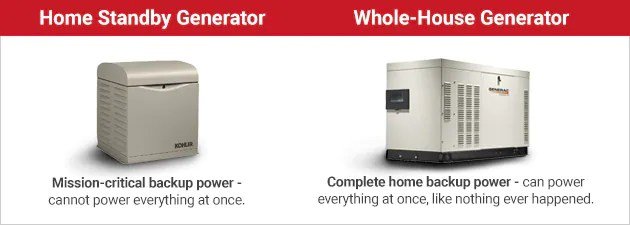
Standby generators are the most robust and convenient home backup solution. These are permanent installations, much like an outdoor HVAC unit, designed to activate automatically the moment a power outage occurs.
- Best For: Providing continuous, automatic power to an entire home or critical circuits for extended periods. Ideal for homeowners who cannot manually operate a generator or require uninterrupted power for medical devices.
- Power Output: The most powerful option, ranging from 7,000 watts for essential circuits to 22,000+ watts for whole-home coverage.
- Fuel: Runs on your home's natural gas line or a liquid propane tank, offering extended run times without manual refueling.
- Pros: Fully automatic operation (detects outages, starts, transfers power, shuts off when utility power returns), runs for days or weeks, powers entire homes, quieter than conventional portables, adds home value.
- Cons: Significantly higher upfront cost, requires professional installation, including an automatic transfer switch and fuel line connection, and regular maintenance. Understanding standby generator installation costs is crucial for budgeting.
The Language of Power: Running Watts vs. Starting Watts
Before you can size a generator, you need to speak its language: watts. There are two critical terms you must understand:
- Running Watts (Rated Watts): This is the continuous power an appliance needs to operate once it's already on. Think of it as the steady demand. For example, a light bulb uses only running watts.
- Starting Watts (Surge Watts): Many appliances, especially those with electric motors or compressors (like refrigerators, freezers, sump pumps, air conditioners), require an extra burst of power for a few seconds to kick-start. This "surge" can be 2 to 3 times their running wattage. Once they start, they revert to their running wattage.
The catch: Your generator must be able to handle this momentary surge from the largest motor-driven appliance that might start while other essential devices are already running. This is the key to avoiding an overloaded, tripped generator.
The Sizing Roadmap: A Step-by-Step Calculation
Now, let's get down to the numbers. This systematic approach ensures you select a generator that precisely meets your needs without overspending or falling short.
Step 1: Identify Your Power Priorities
This is your most crucial first decision, dictating the scope and scale of your generator.
- Whole-Home Backup: Do you want to power everything as if the grid never went down? This includes HVAC, kitchen appliances, water heaters, all lights, and electronics. This typically requires a large standby generator.
- Partial/Essential Backup: Will you focus on just the necessities? This often includes the refrigerator, freezer, furnace fan, well pump/sump pump, key lighting, phone charging, and perhaps a TV. This can be covered by a smaller standby or a larger portable generator with a manual transfer switch.
- Portable or Targeted Use: Are you only looking to run a few select devices for short outages, like a coffee maker, phone chargers, a lamp, or a radio? A smaller portable or inverter generator would suffice.
Step 2: List Devices and Their Wattage
Gather your data. For each essential appliance identified in Step 1, find its running watts (RW) and starting watts (SW).
- Where to find this: Check the appliance's owner's manual, the data plate usually found on the back or bottom of the appliance, or the manufacturer's website. If only one wattage is listed, assume it's the running wattage, and use a general multiplier (2-3x) for an estimated starting wattage for motor-driven devices.
- Create a Table: A simple spreadsheet or piece of paper will help organize this.
| Appliance | Running Watts (RW) | Starting Watts (SW) (if applicable) |
| :--------------- | :----------------- | :---------------------------------- |
| Refrigerator | 700 | 2,200 |
| Freezer | 500 | 1,500 |
| Sump Pump | 1,000 | 2,100 |
| Furnace Fan (gas)| 800 | 1,200 |
| LED Lights (total)| 300 | - |
| Microwave | 1,000 | 1,800 |
| TV / Modem / Router | 200 | - |
| Phone Charger(s) | 50 | - |
| Add all your items here | ... | ... |
Step 3: Calculate Your Peak Demand Wattage
This is where the running and starting watts come together. Your generator needs to handle the highest possible power draw at any single moment.
- Sum All Running Watts: Add up the running watts for all the devices you want to power simultaneously.
- Example (using list above): 700 (Fridge) + 500 (Freezer) + 1,000 (Sump) + 800 (Furnace) + 300 (Lights) + 1,000 (Microwave) + 200 (TV/Modem) + 50 (Chargers) = 4,550 Running Watts
- Identify the Largest Starting Wattage: Look at your list and find the single appliance with the highest starting wattage. This is the appliance that will demand the biggest surge.
- Example: Refrigerator (2,200 SW) is the highest in our sample list.
- Calculate Peak Demand: Now, we'll imagine this largest starting watt appliance kicks on while everything else is already running at its running wattage.
- Subtract the running watts of the highest starting-watt appliance from your total running watts calculated in step 1.
- Add the starting watts of that same appliance to the new sum.
- Example (continued):
- Total Running Watts: 4,550 RW
- Running Watts of Refrigerator: 700 RW
- Starting Watts of Refrigerator: 2,200 SW
- Calculation: (4,550 RW - 700 RW) + 2,200 SW = 3,850 + 2,200 = 6,050 Peak Demand Watts
This 6,050 watts represents the absolute highest power spike your generator will need to handle.
Step 4: Add a Safety and Growth Buffer
Once you have your peak demand wattage, don't stop there. It's smart to add a 20% to 25% buffer. This buffer accounts for:
- Generator Efficiency: Generators run more efficiently and last longer when not constantly pushed to their absolute maximum.
- Future Needs: You might add another small appliance or device later.
- Unexpected Surges: Provides a cushion for any unforeseen power demands.
- Example (continued): 6,050 Peak Demand Watts * 1.25 (for a 25% buffer) = 7,562.5 Watts
So, for our example scenario, you would need a generator rated for at least 7,500 – 8,000 running watts to comfortably handle your essential appliances, including the largest starting surge.
General Wattage Guidelines for Quick Reference
While the step-by-step calculation is precise, these general tiers can offer a quick sense of what wattage range you might be looking at:
- 500 to 3,000 Watts: Perfect for recreation, small power tools, a few lights, and charging devices. Think camping or a minimal emergency kit.
- 3,100 to 6,000 Watts: Good for basic home backup – refrigerator, freezer, furnace fan, essential lights, TV. Can also handle some mid-size appliances.
- 6,100 to 10,000 Watts: Strong emergency power for most essential large appliances, well pumps, furnace, and potentially a small window AC unit. Many larger portable generators fall into this range.
- 10,100 Watts and Above: The realm of whole-home backup. These generators can power most, if not all, of your home's circuits, including central air conditioning and electric water heaters, especially in standby models.
Beyond Watts: Making the Right Selection
Once you have your target wattage, consider these factors to choose the specific generator type and model:
- Fuel Type:
- Gasoline: Common for portables, but fuel degrades, and storage can be an issue.
- Propane (LP): Cleaner-burning, longer shelf life than gasoline, but less energy-dense, meaning you'll burn more. Common for dual-fuel portables and standby units (often requires a large tank).
- Natural Gas: The most convenient for standby generators, directly connected to your home's gas line for unlimited run time (as long as gas service is available). Not practical for portables.
- Diesel: Less common for residential, but very fuel-efficient and durable.
- Noise Level: Measured in decibels (dB). Inverter generators are significantly quieter (50-60 dB) than conventional portables (70-80 dB). Standby generators vary but are generally designed to be less disruptive than large portables.
- Run Time: How long can it run on a single tank of fuel or continuous fuel supply? This is critical for extended outages. Standby generators running on natural gas offer indefinite run times.
- Portability vs. Permanent Installation: Do you need to move it around, or do you want a set-it-and-forget-it solution? This directly relates to the generator type.
- Transfer Switch:
- Manual Transfer Switch: Required for connecting portable generators to your home's electrical panel. An electrician installs this. You manually flip a switch to transfer power from the grid to the generator.
- Automatic Transfer Switch (ATS): Comes standard with standby generators. It detects outages, starts the generator, transfers power, and then switches back and shuts down the generator when utility power is restored—all without any action from you. This is a key component of how a transfer switch works to ensure safety and convenience.
Essential Generator Safety Requirements: Non-Negotiable Rules
Operating a generator carries significant risks if not handled correctly. Your safety and the safety of your family and neighbors must be the top priority.
- Carbon Monoxide (CO) — The Silent Killer: Generators emit carbon monoxide, an odorless, colorless, and deadly gas.
- NEVER operate a generator indoors, including garages, basements, sheds, or enclosed patios. Even with an open garage door, CO can accumulate to dangerous levels.
- Keep running generators at least 20 feet away from your home, doors, windows, and vents. Position the exhaust away from any occupied buildings.
- Install battery-operated CO detectors with alarms in your home, especially near sleeping areas.
- Electrical Safety:
- NEVER plug a generator directly into a standard electrical wall outlet (this is called "backfeeding"). This can send power back into the utility grid, electrocuting utility workers. It can also damage your home's electrical system and potentially start fires.
- Always have a qualified electrician install a transfer switch (manual or automatic) to safely connect a generator to your home's electrical system.
- Use heavy-duty, outdoor-rated extension cords that are appropriate for the load they're carrying. Inspect cords for damage before each use.
- Fuel Handling:
- Allow gas-powered generators to cool down completely before refueling. Gasoline poured onto hot engine parts can ignite.
- Do not overfill the fuel tank. Leave room for expansion.
- Store fuel in approved containers in a well-ventilated area, away from living spaces and heat sources.
- Weather Protection:
- Do not operate a generator in adverse weather conditions like rain or snow unless it is protected by a covered, well-ventilated shelter specifically designed for generator use. Moisture can cause electrocution or damage the generator.
- Overloading:
- Never overload a generator. Ensure its wattage rating is sufficient for the total running and starting watts of all connected appliances. Overloading can damage the generator and appliances, and pose a fire hazard.
- Maintenance:
- Follow the manufacturer's recommendations for generator maintenance schedule, including oil changes, spark plug replacement, and filter checks. Proper maintenance ensures reliable operation and longevity.
- Before storing, drain the fuel or use a fuel stabilizer to prevent gumming and corrosion.
By adhering to these safety guidelines, you can harness the power of your generator without putting anyone at risk. For a deeper dive into safe practices, check out our guide on essential generator safety tips.
Common Questions and Misconceptions
Let's clear up some common confusions about generators.
Q: Can I just plug my generator into a wall outlet?
A: Absolutely not! As mentioned above, "backfeeding" is extremely dangerous and illegal. It can electrocute utility workers and damage your home's electrical system. Always use a transfer switch installed by a licensed electrician.
Q: Do I need to run my standby generator regularly?
A: Yes! Most standby generators perform weekly self-tests for a short period (e.g., 10-20 minutes). This "exercise" cycle keeps the engine lubricated, charges the battery, and ensures it's ready to go when needed. Skipping these can lead to issues during an actual outage.
Q: Is a bigger generator always better?
A: Not necessarily. While it's crucial not to undersize, an oversized generator incurs higher upfront costs, burns more fuel than needed, and can sometimes even lead to "wet stacking" (unburned fuel residue buildup) if it consistently runs below its optimal load. Matching your needs to your capacity is key for efficiency and longevity.
Q: How long can a generator run continuously?
A: This depends heavily on the type and fuel. Portable generators typically run for 8-12 hours on a tank of gasoline before needing a refill. Standby generators running on natural gas can run continuously for days or even weeks, as long as the fuel supply is uninterrupted. Propane-fed standby units are limited by the size of their propane tank. Always consult the manufacturer's specifications.
Q: Will a generator increase my home's value?
A: A permanently installed standby generator can indeed add significant value to your home, often recouping a substantial portion of its cost. It's viewed as a major home improvement and a desirable feature, especially in areas prone to outages. Portable generators, while useful, generally don't impact home value in the same way.
Your Next Step: Power Up with Confidence
Sizing and selecting your home backup generator might seem complex at first, but by following a methodical approach, you can arrive at a solution that perfectly fits your needs and budget. Start by listing your priorities, then meticulously calculate your wattage requirements, making sure to account for those crucial starting surges and a safety buffer.
Once you have your numbers, you can confidently compare the types of generators—portable for flexibility, inverter for quiet efficiency, or standby for automatic, whole-home reliability. Remember to always prioritize safety in installation and operation, adhering strictly to guidelines regarding carbon monoxide and electrical connections.
With this knowledge in hand, you’re no longer just buying a piece of equipment; you're investing in uninterrupted comfort, safety, and peace of mind for your family, come what may. Take the time to do it right, and you'll be prepared for anything Mother Nature throws your way.